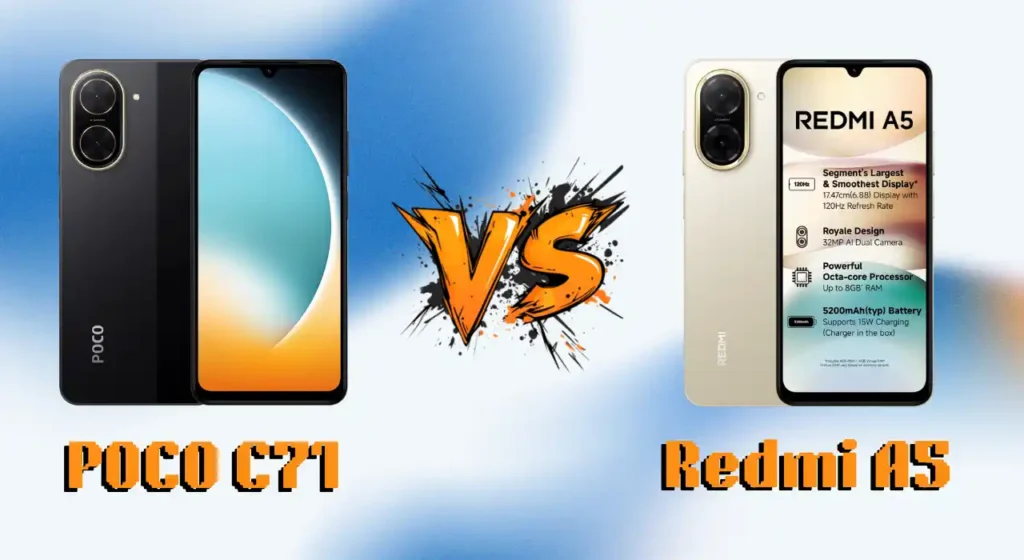
In the crowded world of budget smartphones, two models often grab attention from users who want a large screen, solid basics, and good battery life without spending too much — the POCO C71 VS Redmi A5. Both phones aim to offer the best value for money, but they come from slightly different design philosophies and target audiences.
In this article, we’ll break down all the key areas — display, performance, camera, battery, software, and more — in simple, everyday language. Whether you’re buying your first smartphone or upgrading from an old one, this comparison will help you decide which one is right for you.
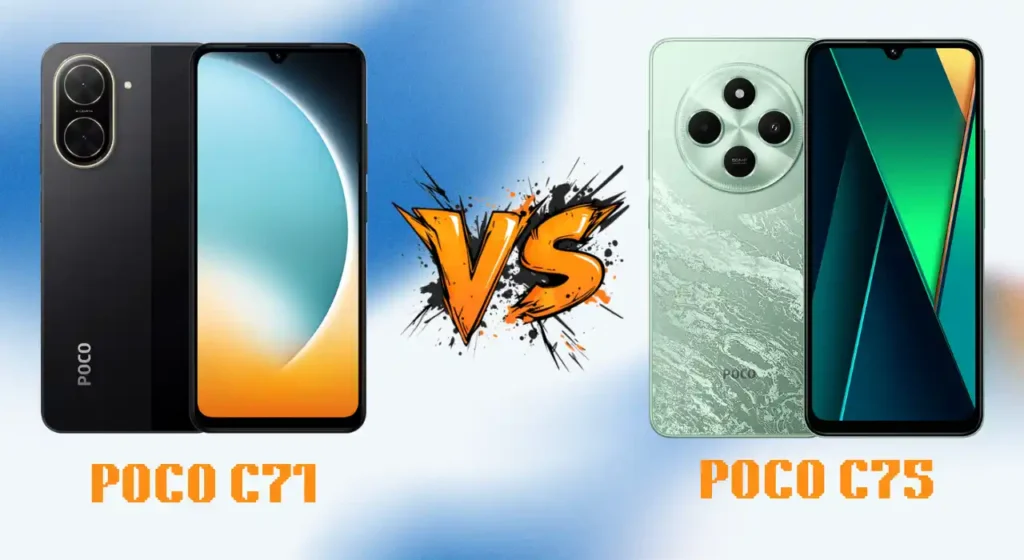
And if you’re also curious how the POCO C71 stacks up against other options, don’t miss our detailed comparison of POCO C71 vs POCO C75.
POCO C71 VS Redmi A5: Design & Look
When you first hold the POCO C71 and the Redmi A5, you’ll notice a lot of similarities:
- Both phones have big 6.88-inch displays with thin bezels, making them perfect for watching videos and scrolling social media.
- Each phone uses plastic body panels, which is standard in this price range, yet they are built to feel solid in hand.
- The overall weight of both phones sits around 193 grams, which is comfortable for long sessions without feeling too heavy.
Still, subtle differences in finish and colour options might matter if style is a priority. Both phones have splash resistance and modern minimal looks, but neither comes with premium glass or metal materials — something that’s expected in this budget class.
Who wins here?
It’s a tie in design. Both offer a clean, modern look and feel that’s more than enough at this price.
Display Quality: POCO C71 VS Redmi A5
One of the biggest talking points for both phones is their large displays:
- Both the POCO C71 and Redmi A5 feature a 6.88-inch IPS LCD screen with 120 Hz refresh rate. This means smoother scrolling and better animation quality compared to older phones that have 60 Hz screens.
- The resolution on both is HD+ — not Full HD — which is perfectly fine for everyday use like browsing, chatting, and streaming.
Although they share the same display size and refresh rate, some sources suggest possible brightness differences between the two when used outdoors. But in normal indoor viewing, both screens offer good colour reproduction and responsiveness.
Verdict:
If you like big screens with smooth motion, you’ll enjoy both phones. There’s no clear winner here — they’re essentially equal in display quality.
Performance: Speed & Everyday Use
Performance is where things get a little more nuanced:
- Both phones run on the Unisoc T7250 chipset — the same basic engine powering daily tasks like social media, video streaming, chatting apps, and light gaming.
- POCO C71 generally comes with 4 GB or 6 GB RAM, giving it a slight edge for multitasking and keeping more apps open at once.
- Redmi A5 might offer 3 GB or 4 GB RAM in some configurations, which can feel a bit slower when switching between multiple apps.
Both phones handle basic tasks comfortably, but if you like keeping many apps open or occasionally play light games, the extra RAM options on the C71 make it feel a bit smoother in everyday use.
Performance Winner:
POCO C71 by a small margin, especially if you choose the 6 GB RAM model.
Cameras: Real-Life Photo Quality
In terms of camera hardware, both phones pack similar specs:
- Rear Camera: 32 MP primary shooter on both devices.
- Front Camera: 8 MP selfie camera on both.
That sounds like a tie, but as usual in budget phones, software optimization matters a lot. Most users find that both phones take decent photos in bright daylight, capturing reasonable detail and colours. However, in dim lighting, you might notice:
- Grainy shadows
- Lower clarity
- Colors that look less punchy
This is common for phones in this price range — so don’t expect flagship quality here. For social media photos, casual selfies, and midday outdoor shots, both phones perform well enough.
Photo Tip: Try to shoot in good light — that’s when budget phones shine the most.
Camera Verdict:
It’s a draw. Neither phone is dramatically better here — both get the job done.
Battery & Charging: How Long Do They Last?
Battery life often matters most for daily users, and here both phones impress:
- Both have a 5200 mAh battery — large enough to last a full day of regular use.
- Charging speed on both is rated at 15 W, which isn’t super fast, but manageable.
Real-world use shows that you can easily go through a whole day of browsing, calling, texting, and video streaming without needing a recharge. Heavy users might need a top-up in the evening, but that’s true of most budget phones.
Who wins?
There’s no real advantage here — battery performance is basically the same.
Software & Updates: What They Run
Software is an important but often overlooked part of the experience:
- Both phones run Android 15 Go Edition, which is lighter and smoother on entry-level hardware.
- They also come with HyperOS, Xiaomi’s new interface that’s simple and easy to navigate.
- Both promise a couple of years of Android updates and security patches.
What this means is a smoother experience compared to older Android versions, plus some useful features without overwhelming the user with clutter.
Software Takeaway:
Both phones offer a fresh and responsive software experience, so this point is a tie.
Price & Value: Which One Gives You Better Bang for Buck?
Price is a big deal when comparing these two:
- The POCO C71 usually sits at a slightly lower price point compared to the Redmi A5 in most markets, especially in the base variants.
- The Redmi A5 may offer slightly higher storage (like 128 GB options) in certain variants, attracting users who like more space for photos and videos.
Overall, both phones offer excellent value. But if you’re a first-time smartphone buyer or want the best basic performance for under a tight budget, the POCO C71 is often considered the better deal — especially when you factor in its slightly better RAM options and overall balance of features.
Final Verdict: Which One Should You Pick?
After looking at all the important factors, here’s a simple breakdown:
📌 Choose POCO C71 if:
- You want better multitasking with more RAM options
- You want a slightly smoother daily performance
- You care about value for money
📌 Choose Redmi A5 if:
- You prefer a trusted Redmi brand experience
- You want possibly higher storage configurations
- You like its specific design or colour options
In the end, both phones are solid choices for anyone looking for a budget-friendly smartphone in 2025. They offer big screens, dependable performance, great battery life for the price, and friendly software experiences. Just pick the one that fits your priorities — performance, storage, or price.