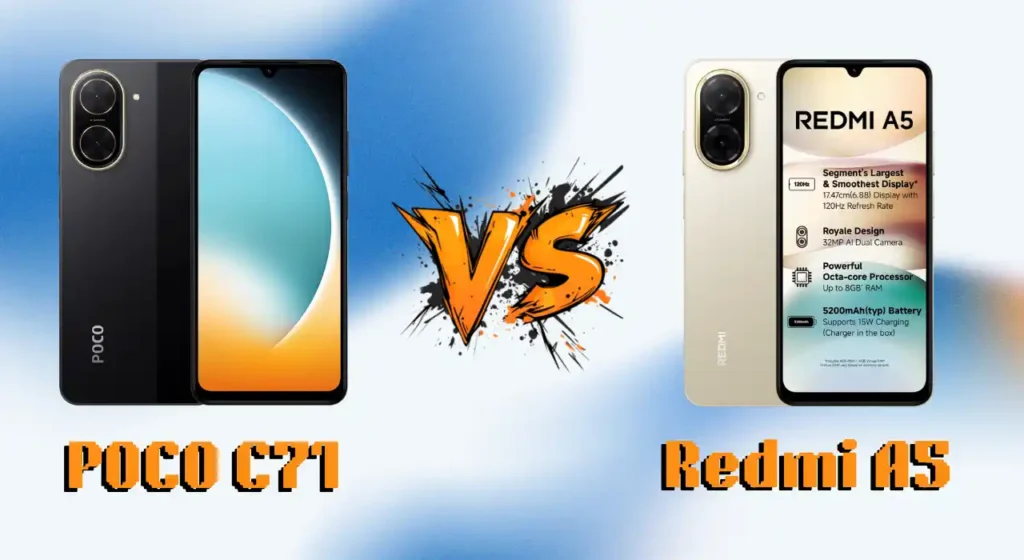
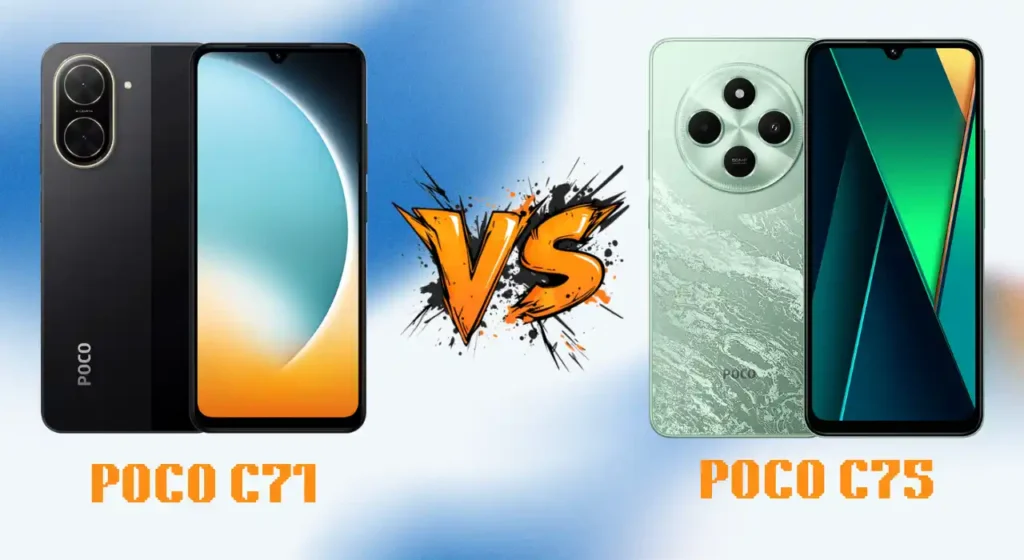
When it comes to budget-friendly smartphones that offer big screens and decent performance without burning a hole in your pocket, Poco C71 VS Poco C75 5G are two names that keep popping up. Both phones target entry-level users looking for the best value for money, but which one truly deserves your hard-earned cash? In this in-depth comparison, we’ll explore how these two stack up across design, display, performance, cameras, battery, software and more in a human-friendly tone, so you don’t get lost in jargon.
Whether you’re shopping on a tight budget or just want to know which phone to gift a teen or senior, this guide breaks everything down for you. Let’s get started!
Overview: POCO C71 VS POCO C75
Before we dive deep, here’s a snapshot of what these two phones bring to the table:
- The POCO C71 is a more recent release aimed at delivering simple everyday performance with a surprisingly polished build and software experience.
- The POCO C75, on the other hand, arrived earlier and focuses on slightly stronger hardware and camera capabilities — all while staying within a reasonable price range.
If you want to explore other popular budget contenders, don’t forget to also check out the excellent Redmi Note 15 Pro Max, which offers a big step up in performance and features.
Now, let’s compare these two star smartphones section by section.
Design & Build Quality
Both phones share a large 6.88-inch display, giving them a bold presence in hand and great real estate for videos and browsing.
- POCO C75 has a slightly larger and more substantial feel, weighing around 204 g — a bit heavier than the C71.
- POCO C71 is lighter at about 193 g, which might make it more comfortable for one-handed use.
Both phones generally adopt plastic builds with splash-resistance, and both come in a range of colours that make them look more premium than their price tags suggest.
Verdict: Comfortable for everyday use, but the C71’s lighter weight could be better for long sessions.
Display: Big Screen Wins
Here’s where both phones are pretty much twins:
- 6.88-inch IPS LCD panels with 120 Hz refresh rate on both devices.
- Resolution sits at HD+ (720 × 1640) — not the sharpest, but fine for streaming and social media.
- Colours and brightness are decent, though not as punchy as higher-end smartphones.
The high refresh rate ensures scrolling and animations feel smoother than most phones in this price class.
Quick Take: Both phones offer the same immersive large display experience. No clear winner here.
Performance: Everyday Speed Test
This is where things start to diverge:
- POCO C75 gets a stronger processing backbone thanks to a MediaTek Helio G81 Ultra or Snapdragon 4s Gen 2 chipset (depending on the variant), which handles multitasking and light gaming better than its rival.
- POCO C71 runs on the Unisoc T7250, which is fine for browsing, videos, and social apps but struggles a bit under heavier loads.
Both phones typically ship with 4 GB or more RAM and expandable storage, but C75 often offers higher storage and RAM configurations.
Bottom Line: If smooth performance under load matters to you, the C75 takes the edge.
Camera Clash
Camera specifications can be confusing, but here’s the simple version:
Rear Cameras
- POCO C75: 50 MP primary shooter — better clarity and detail in photos.
- POCO C71: 32 MP main camera — decent but not as crisp on closer inspection.
Front Cameras
- C71 surprisingly has a stronger 8 MP selfie camera compared to the 5 MP unit on the C75.
Both can record decent 1080p video and handle everyday shots well in good light, but in dim conditions, they’re more average. Don’t expect flagship-level photography here — just solid everyday images.
Verdict:
- Better main camera? C75
- Better selfies? C71
Battery Life & Charging
Both handsets house large batteries that easily last a full day on moderate use:
- POCO C71: ~5200 mAh battery with 15W charging — full charge takes a bit longer.
- POCO C75: Slightly smaller 5160 mAh battery but with 18W fast charging — a faster top-up experience.
Either way, you’ll likely get a full day’s usage with typical social media browsing, videos, and calls.
Quick Summary: C75 wins marginally for charging speed, C71 slightly edges battery capacity — so it’s a wash.
Software & Updates
- POCO C71 runs Android 15 (Go Edition) with HyperOS — optimized for lighter hardware and smoother performance.
- POCO C75 often ships with Android 14 and HyperOS, still solid but not as fresh out of the box.
Both promise a couple of years of updates and security fixes, making them solid buys in their price brackets.
Takeaway: C71’s software feels more up-to-date, which is great if you want longer software freshness.
Price & Value for Money
Price changes often with offers, but generally:
- POCO C71 is priced lower, making it an excellent value for entry-level users.
- POCO C75 costs a bit more but brings stronger hardware, camera focus, and faster charging.
If you’re on a tight budget, C71 gives you more bang for your buck. But if performance and camera matter, C75 is worth the extra investment.
Final Verdict: Which One Should You Choose?
Both phones are very capable entries in the budget segment, and the better choice depends on what you value most:
Choose POCO C71 if:
- You want fresher software and lighter UI performance.
- You prefer a better selfie camera.
- Value for money is your top priority.
Choose POCO C75 if:
- You want stronger performance for multitasking and casual gaming.
- Main camera quality matters to you.
- You prefer faster charging and higher storage/RAM options.
And if you’re willing to stretch your budget just a bit more for a significant performance and camera upgrade, don’t miss checking out the Redmi Note 15 Pro Max internal link above — it’s a next-level device that outshines both these phones.